
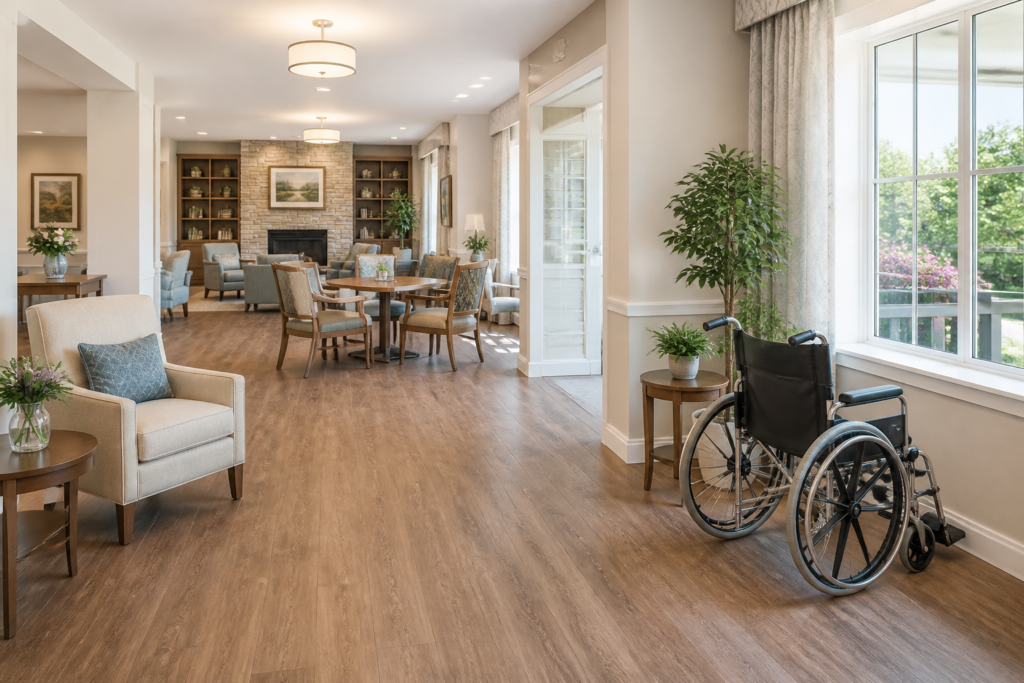
Yes, some personal care homes can accommodate wheelchair users, but acceptance depends on more than ramps or wide doorways. In Georgia, the home must determine whether the resident can move, transfer, respond to an emergency, and receive needed daily assistance within the home’s licensed scope. Families should confirm these details through an assessment before choosing a residence.
What Georgia rules mean for wheelchair users
Georgia’s personal care home rules generally distinguish between a wheelchair user who can self-propel and evacuate with minimal assistance and a resident who cannot safely move or exit without substantial help. A person who moves around by propelling a wheelchair or scooter may be considered ambulatory when they can respond to an emergency and leave with minimal assistance.
Minimal assistance may include verbal direction, guidance, or limited physical help such as assistance with a transfer. After the transfer, the resident generally needs to be able to self-propel the wheelchair. The Georgia personal care home regulations describe these admission and mobility requirements.
This means a wheelchair user may be appropriate for a personal care home, while someone who cannot self-propel, needs extensive transfer assistance, or cannot evacuate safely may require a different level of care. Georgia Department of Community Health interpretive guidance explains that needs beyond permitted assistance with ambulation or transfers can fall outside a personal care home’s scope. The resident’s individual abilities and care plan matter more than the wheelchair itself.
When aging in place may apply
Georgia allows a personal care home to retain up to three non-ambulatory residents under an aging-in-place exception. This is not an automatic entitlement or a guarantee that every home can accept a non-ambulatory wheelchair user.
The exception has specific conditions. The resident’s condition must not have changed significantly in a way that makes continued placement inappropriate, and the home must be able to meet the person’s needs within its licensed scope. The home must also be able to evacuate residents safely within the required timeframe, maintain appropriate staffing, conduct required fire drills, and meet other regulatory conditions.
Families should ask whether the home has experience with this type of placement and whether the resident’s current abilities meet the home’s admission criteria. If mobility or medical needs change later, the home should explain how it reassesses the resident and what transition options may be available.
Accessibility involves more than an entrance ramp
For a wheelchair user, the practical layout of the home can affect safety and independence every day. Georgia rules address access to living, dining, and activity areas, as well as doorways and corridors that accommodate permitted mobility devices.
During a tour, look at the entire route from the bedroom to the bathroom, dining room, common areas, and exits. Pay attention to thresholds, tight turns, floor surfaces, furniture placement, and whether the resident can maneuver without depending on staff for every movement.
Other accessibility questions include:
- Is the bedroom on the ground level, or is there an accessible ramp or elevator?
- Can the resident enter and turn around comfortably in the bedroom and bathroom?
- Can the resident use bathroom fixtures independently where they are able to do so?
- Are there two appropriately located emergency exits accessible to residents who depend on wheelchairs or scooters?
- Are entrances, sidewalks, yards, and escape routes clear of hazards?
- Can a manual wheelchair, power wheelchair, or scooter be stored and charged safely?
A home may describe itself as accessible, but families should verify the specific features that matter to their loved one. A home’s physical setup and its admission criteria may differ from those of another residence.
What care can staff provide?
Wheelchair users may need help with activities of daily living in addition to mobility. Personal care services can include assistance with transfers, ambulation, bathing, grooming, dressing, toileting, eating, and medication assistance. The home should have enough staff time to provide needed help with transfers, hygiene, meals, and routines intended to reduce risks such as pressure injuries and loss of mobility.
However, a personal care home is not a substitute for continuous nursing or continuous medical services. Periodic nursing, therapy, or other health services may need to be provided by appropriately licensed professionals independent of the home. The home may help coordinate those services, but families should clarify who provides them and how often.
For an overview of services to discuss with a prospective residence, visit Comfort Cove Senior Living’s services page and care options. These resources can help families organize questions, but the resident still needs an individualized assessment.
Questions to ask personal care homes in Gwinnett County that accept wheelchair residents
Whether you are comparing homes near Lawrenceville, the Mall of Georgia, or elsewhere in Gwinnett County, ask the same practical questions at each location:
- Do you accept residents who use manual wheelchairs?
- Do you accept residents who use power wheelchairs or scooters?
- Can staff assist with transfers? If so, what level of assistance is available?
- Must the resident be able to self-propel the wheelchair?
- Where would the resident’s bedroom be located, and is the route accessible?
- How many wheelchair-accessible emergency exits are available?
- Can the resident safely enter, turn around, and use the bathroom?
- How are bathing, toileting, dressing, meals, medication assistance, and mobility support handled?
- What happens if the resident’s mobility or medical needs increase?
- Does the admission agreement clearly explain included services, additional charges, transportation, and transfer or discharge procedures?
Georgia requires an admissions interview, a recent physical examination report, a resident-needs assessment, and an admission agreement covering services and other important terms. The state regulations provide the governing details. Families should review the agreement carefully and ask a qualified professional about any provision they do not understand.
How to verify a home before choosing it
Do not rely only on an online directory or the word accessible in an advertisement. Call the home, describe the resident’s actual abilities, and ask for a tour with the wheelchair or mobility device the resident uses. If possible, observe a transfer and discuss evacuation expectations with the appropriate staff member, while respecting the resident’s privacy and dignity.
Families can also use the Georgia Department of Community Health’s GaMap2Care facility search to review facility information, licensing details, available inspection materials, rules, and complaint resources. These tools are useful for due diligence, but they do not replace a conversation about whether a particular home can safely meet one resident’s needs.
Comfort Cove Senior Living is a licensed personal care home in Lawrenceville serving families in Gwinnett County. If you are considering the home, use the contact page to ask about wheelchair access, transfer assistance, emergency planning, and the assessment process. A tour of the home can help you evaluate the layout and daily environment in person.
Frequently asked questions
Can a person who uses a wheelchair live in a Georgia personal care home?
Possibly. A wheelchair user who can self-propel and respond to an emergency with minimal assistance may meet general personal care home criteria. The home must still confirm that it can provide the required daily assistance safely.
Can staff help a wheelchair user transfer?
Some transfer assistance may be allowed, but the amount and type of help available can vary by home. Ask specifically whether staff can provide a one-person transfer, whether additional equipment is needed, and whether the resident must self-propel after the transfer.
What if the resident cannot self-propel?
A resident who cannot self-propel or who needs more than limited assistance may require care beyond a standard personal care home’s permitted scope. An aging-in-place exception may apply in some circumstances, but it has specific conditions and must be confirmed with the home.
Does an accessible building guarantee admission?
No. A ramp, elevator, or accessible bathroom addresses the physical environment, but admission also depends on transfers, evacuation, staffing, daily care, and medical needs. The home should complete an assessment before making a decision.
What should families do if needs change after move-in?
Ask the home how it reassesses residents, what services can be added, and when a transfer to another setting may be necessary. Families should also involve the resident’s healthcare professionals when evaluating changes in mobility, nursing needs, or safety.
A personal care home may accommodate a wheelchair user, but the right answer depends on the resident and the setting together. Confirm self-propulsion and evacuation abilities, inspect bedrooms and bathrooms, discuss transfer support, and make sure the home’s staffing and licensed services match the care plan before making a decision.
Sources
- GA R&R – GAC – Subject 111-8-62 PERSONAL CARE HOMES
- Microsoft Word – PCH Interpretive Guidelines.doc
- GaMap2Care®-Find a Facility | Georgia Department of Community Health