Medication support in a personal care home may include reminders, secure storage, supervision, or physical help while a resident takes medication. In Georgia, the exact service depends on the home’s license, the resident’s ability to self-administer, staff training, and the medication involved. Families should ask how support is provided, documented, and communicated when prescriptions change.
What medication support can mean
The phrase medication support does not have one universal meaning. In a Georgia personal care home, it may refer to limited assistance with self-administration rather than the same type of medication administration provided in a nursing home or by a licensed nurse.
Georgia’s personal care home rules distinguish between self-administration and assistance with self-administration. A resident who can identify a medication, understand generally when it should be taken, and recognize its physical characteristics may be able to self-administer. If that resident needs help handling the medication, trained staff may be able to assist within the limits of the rules and the home’s authorization.
Depending on the situation, assistance may include:
- Retrieving a properly labeled medication from secured storage
- Reading the pharmacy label to the resident
- Opening the container and removing the prescribed amount while the resident is present
- Placing an oral dose in the resident’s hand or another container at the resident’s request
- Helping with prescribed topical medications, drops, inhalers, nasal sprays, or patches
- Returning the medication to secured storage
More extensive medication administration may involve a licensed nurse, proxy caregiver, or certified medication aide when permitted by Georgia requirements and the home’s license. A home may not be able to accept or continue serving a resident whose medication needs exceed the services it is authorized and equipped to provide. This is one reason a careful assessment is important before move-in and whenever a resident’s condition changes.
How staff roles and training support safety
Medication support should be provided by staff whose responsibilities match their training and the services the home is allowed to offer. Georgia rules require documented medication training for unlicensed staff who assist with or supervise self-administration. Training topics include reading prescription labels and common abbreviations, following the right medication, resident, time, amount, and method, storing and disposing of medication, infection control, recognizing side effects and adverse reactions, and completing the Medication Assistance Record.
Staff must demonstrate competency when hired and at least annually for the medication tasks they perform, according to the Georgia personal care home regulations. In settings that use certified medication aides where authorized, additional requirements can apply, including registry verification, competency checks, and oversight by a licensed nurse or pharmacist.
Families can reasonably ask who provides medication support on each shift, how new staff are trained, and who supervises the process. A home should also be able to explain what happens if a resident begins refusing medication, has difficulty swallowing, experiences a possible reaction, or can no longer safely self-administer.
Medication records: what the MAR does
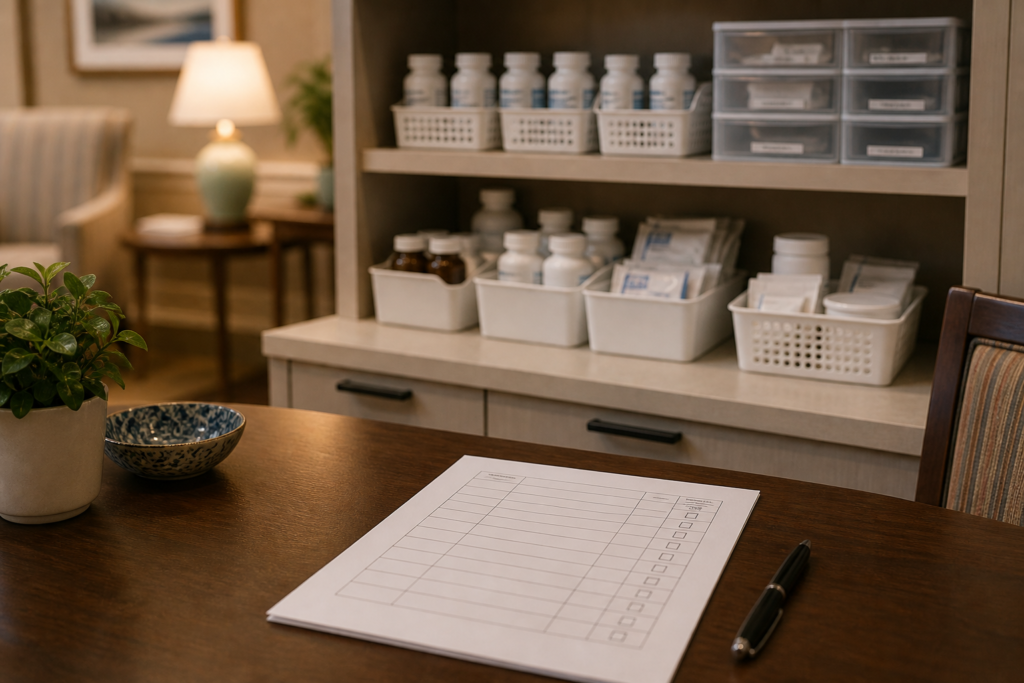
When a home assists with, supervises, or administers medications, it must maintain a daily Medication Assistance Record, commonly called a MAR, for each resident receiving the service. The MAR helps staff follow current instructions and creates a record of medication events.
Information generally recorded or made available includes:
- The resident’s name and known allergies
- The prescribing health-care provider’s name and telephone number
- The medication name, strength, and directions
- Relevant severe side effects, adverse reactions, and contraindications
- The date, time, and staff initials when medication is taken or refused
- Missed doses, medication errors, or other significant concerns
Staff should update the record each time medication is offered or taken. Unusual reactions should be documented and communicated to the resident, representative, and health-care provider as appropriate. Prescription refills also need to be handled in time to avoid interruptions in routine dosing. When a new medication arrives, the MAR generally must be updated within 48 hours, or sooner when the prescriber directs an immediate change, under the state rules.
A MAR is an important safety tool, but it does not replace communication with the prescribing clinician or pharmacist. It is also not a substitute for a medical evaluation when a resident has a new or worsening symptom.
How families can help during medication changes
Medication problems often arise during transitions between a hospital, physician’s office, pharmacy, and personal care home. The Agency for Healthcare Research and Quality identifies medication reconciliation and communication during care transitions as continuing safety challenges.
Families can help by providing an up-to-date medication list, including prescriptions, over-the-counter products, vitamins, supplements, allergies, and prescribing-provider information. Ask the hospital, physician, or pharmacy to send clear instructions when a medication is started, stopped, or changed. Then confirm that the personal care home received the update and knows when it takes effect.
It is useful to clarify:
- Who contacts the prescriber or pharmacist when there is a question
- How the home handles hospital discharge paperwork
- How medication refusals, missed doses, and suspected errors are reported
- How families or authorized representatives can review medication records
- What happens if a pharmacy changes packaging, dosage, or delivery timing
Do not change, stop, crush, split, or combine a medication based only on a general article or family advice. Those decisions should be confirmed with the prescribing clinician or pharmacist, especially when a resident has swallowing difficulties, dementia, kidney disease, allergies, or multiple medications.
Questions to ask when comparing personal care homes
Before choosing a home, ask for specific descriptions rather than relying on a general phrase such as “medication management.” Consider bringing this checklist to a visit:
- What type of medication support do you provide: reminders, assistance with self-administration, or medication administration?
- Which staff members provide the service, and what training or credentials do they have?
- How do you determine whether a resident can self-administer?
- Where are medications stored, and how is access controlled?
- Do you use pharmacy-prepared packaging, original pharmacy-labeled containers, or both?
- How is the MAR completed, reviewed, and corrected if something is missed?
- How are refusals, missed doses, medication errors, and possible side effects handled?
- How quickly are medication changes added to the resident’s records and care instructions?
- Who communicates with the resident’s physician, nurse practitioner, physician assistant, pharmacist, and family representative?
- What happens after a hospital stay or if a resident’s medication needs become more complex?
Medication support at Comfort Cove Senior Living
Comfort Cove Senior Living serves families in Lawrenceville and throughout Gwinnett County with 24/7 personal care, assistance with daily activities, mobility and transfer support, meals, and private or shared suites. Medication support is one part of a broader care plan and should be discussed in relation to the resident’s current abilities, prescriptions, and medical instructions.
If you are considering a personal care home near the Mall of Georgia, you can review our services and care options, then contact Comfort Cove to ask how the team evaluates medication needs and coordinates changes. A tour can also help your family understand the daily routines, storage practices, and communication process before making a decision.
Frequently asked questions
Is medication support the same as medication administration?
No. Medication support may mean reminding, supervising, or physically assisting a resident who remains capable of self-administration. Medication administration by a nurse, proxy caregiver, or certified medication aide may involve different requirements. Ask the home to describe exactly what it provides.
Can staff give a resident any medication the family brings?
Not automatically. Medications should be properly labeled, documented, stored, and handled according to the home’s policies, the resident’s care instructions, and applicable Georgia requirements. Families should coordinate new or changed medications with the home, prescriber, and pharmacy.
What happens if a resident refuses a dose?
The home should have a procedure for documenting the refusal, notifying the appropriate people, and determining whether follow-up with a health-care provider is needed. Ask how refusals are recorded on the MAR and when family members are contacted.
What if a resident can no longer safely self-administer?
The home should reassess the resident’s needs and explain whether it can provide the required level of support under its license and staffing model. The family may need to involve the resident’s clinician and consider other care arrangements if the needed service is outside the home’s authorization.
Can families review medication records?
Families or representatives may be able to review records with appropriate authorization and in accordance with privacy requirements. Ask the home what documentation is available, who may access it, and how updates are shared.
This article provides general information for families evaluating care in Georgia. It is not individualized medical, legal, or regulatory advice. Confirm medication decisions with the resident’s prescribing clinician or pharmacist, and ask the personal care home about its current license, policies, and available services.
Sources
- Personal Care Homes | Georgia Department of Community Health
- GA R&R – GAC – Subject 111-8-62 PERSONAL CARE HOMES
- Rules for Personal Care Homes – Interpretive Guidelines
- GA R&R – GAC – Subject 111-8-62 PERSONAL CARE HOMES
- Medication Reconciliation | Digital Healthcare Research
- Medication Safety and Your Health | Medication Safety | CDC