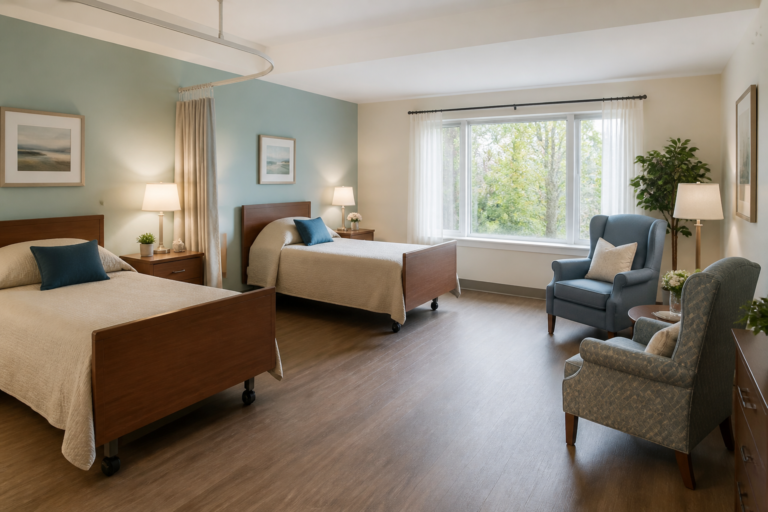
In 2025, the median cost of assisted living in Georgia was about $5,300 per month, or $63,600 per year. That figure is a useful statewide comparison, not a required rate for every personal care home. Smaller homes may price rooms and services differently, so families should request a written fee schedule and compare what the monthly charge includes.
Georgia’s personal care home cost benchmark
The latest statewide benchmark identified for this topic comes from CareScout’s 2025 Cost of Care Survey, conducted from July through November 2025 and published in 2026. It reported a Georgia median of $5,300 per month for an assisted living community, equal to approximately $63,600 per year. The national median was $6,200 per month.
CareScout describes this figure as a private, one-bedroom monthly rate for an assisted living community. It is not a quote from Comfort Cove Senior Living or any other specific residence, and it does not establish a required price for Georgia personal care homes. You can review the methodology and state figures in the CareScout 2025 Cost of Care Survey.
For families searching for the personal care home cost in Georgia, the most important point is that the comparison is imperfect. Georgia uses different licensing categories for personal care homes and assisted living communities. A smaller personal care home may offer a different setting, room arrangement, staffing model, and fee structure than a larger assisted living community.
Personal care home and assisted living terminology
Georgia defines a personal care home as a residence that provides or arranges housing, food service, and one or more personal services for at least two unrelated adults. Personal services may include help with daily living activities, ambulation and transfers, and assistance or supervision with self-administered medication.
Georgia also defines an assisted living community as a personal care home serving 25 or more residents that is licensed to provide assisted living care. A personal care home that is not specifically licensed as an assisted living community may not provide assisted living care. Families can review the state’s terminology and provider information through the Georgia Department of Community Health.
Because these categories differ, avoid comparing homes based only on the words “assisted living” or “personal care home.” Ask what level of care the residence is authorized to provide and whether its services match your family member’s current and anticipated needs.
What may be included in a monthly rate?
A monthly charge often reflects more than rent. Depending on the residence and the agreement, it may include some combination of housing, meals, housekeeping, laundry, activities, supervision, and personal care. Other services may be priced separately or based on the amount of help a resident needs.
Potential cost differences may relate to:
- Living arrangement: Private suites generally have a different rate from shared rooms or suites.
- Personal care: Assistance with bathing, dressing, grooming, toileting, eating, or other daily activities may be included, tiered, or billed separately.
- Mobility and transfers: A resident who needs hands-on help moving between a bed, chair, or bathroom may have different care needs from someone who is independently mobile.
- Medication support: Ask whether assistance, supervision, packaging, acquisition, and refills are included or separately arranged.
- Transportation: Scheduled transportation may be included, limited, or reimbursed separately.
- Memory-related services: Dementia-related supervision or programming may involve separate requirements or charges.
- One-time fees: Assessment, move-in, administrative, security-deposit, or community fees may apply depending on the home.
Georgia’s personal care home rules require the admission agreement to identify current daily, weekly, or monthly charges, services included in the basic charge, services available for an additional fee, refund policies, transportation arrangements, and medication responsibilities. Read the Georgia personal care home admission-agreement requirements before signing, and ask the home to explain any language you do not understand.
Questions to ask when comparing homes
A lower advertised rate is not necessarily the lower total cost. Use the same questions for every residence so you can compare the complete monthly picture:
- What is the monthly rate for a private suite and for a shared room?
- Which meals, housekeeping, laundry, activities, and transportation services are included?
- Is help with bathing, dressing, toileting, eating, mobility, or transfers included?
- Are medication assistance, medication packaging, acquisition, or refills charged separately?
- Are there move-in, assessment, administrative, community, or security-deposit fees?
- How are increased care needs assessed and priced?
- Are memory-care or dementia-related services available, and do they involve an additional charge?
- What happens financially if the resident moves out, transfers, or dies?
- How much notice is provided before charges increase?
- Is the home properly permitted and licensed or registered for the services it provides?
Request answers in writing. A clear fee schedule and admission agreement can help prevent an initially appealing rate from becoming difficult to understand later.
How rate increases are addressed
The admission agreement should explain not only today’s charges but also how future increases are handled. Under Georgia’s personal care home rules, residents must receive at least 30 days’ written notice before an increase in charges for personal services and at least 60 days’ written notice before an increase in room-and-board charges.
These notice periods do not mean that future prices will remain fixed. They give families an opportunity to review the change, ask questions, and consider whether the arrangement remains appropriate. For a detailed decision, families may wish to review the agreement with an elder-law attorney, financial adviser, or other qualified professional.
How families may pay for care
Families commonly review personal savings, retirement income, family resources, long-term-care insurance, and potential public benefits. The right approach depends on the resident’s finances, health needs, eligibility, and the residence’s payment policies.
Medicare generally does not pay for long-term custodial care, including most ongoing nonmedical assistance with activities of daily living. Medicare may cover certain medical services in other circumstances, but families should not assume it will pay the monthly cost of a personal care home.
Georgia Medicaid’s Community Care Services Program, or CCSP, and Service Options Using Resources in a Community Environment, or SOURCE, may provide covered services to eligible individuals who meet financial, functional, residency, and nursing-facility-level-of-care requirements. Services may include personal care, alternative living services, meals, adult day care, and respite care. The Georgia Medicaid long-term services and supports page explains the programs and eligibility considerations.
Eligibility for a Medicaid waiver does not guarantee that every personal care home will accept the arrangement, and it does not necessarily cover all room-and-board costs. Ask the home, the Georgia Medicaid program, and an appropriate benefits counselor or professional how payment would work in your specific situation.
Planning a realistic monthly budget
Start with the full monthly rate, then add predictable expenses that are not included. These might include personal toiletries, clothing, salon services, specialist transportation, uncovered medical items, prescriptions, and spending money. Also consider whether the resident’s needs are likely to change over time.
When comparing residences in Lawrenceville, near the Mall of Georgia, or elsewhere in Gwinnett County, ask each home for a written estimate based on the same care profile. A useful comparison includes the room type, assistance needed, medication arrangements, transportation expectations, and any one-time fees. This approach is more reliable than comparing statewide averages with a single home’s basic rate.
Frequently asked questions
What is the average personal care home cost in Georgia?
The closest widely published statewide comparison is the 2025 median assisted living cost of $5,300 per month, or about $63,600 per year. Personal care homes may charge more or less depending on size, location, room type, services, and how care is priced.
Does the $5,300 figure apply to every Georgia personal care home?
No. It is a statewide assisted living benchmark for a private, one-bedroom rate, not a required rate or quote for every personal care home. Georgia’s licensing categories and individual homes’ services can differ.
What should be included in a personal care home contract?
The admission agreement should explain current charges, included services, additional-fee services, refund policies, transportation arrangements, medication responsibilities, and how rate increases are handled. Ask for clarification before signing.
Will Medicare pay for a personal care home?
Medicare generally does not pay for long-term custodial care or most nonmedical help with daily activities. Families should review their own resources, insurance, Medicaid eligibility, and other possible assistance with qualified advisers.
How can I compare care options near Lawrenceville?
Begin by identifying the assistance your family member needs, then compare room options, services, staffing questions, fees, contract terms, and licensing information. You can also review Comfort Cove’s care options and services, then contact Comfort Cove to ask questions or schedule a tour.
A thoughtful next step
Cost is an important part of the decision, but it should be considered alongside safety, dignity, daily support, communication, and the home’s ability to meet changing needs. If you are exploring personal care in Gwinnett County, visiting a residence and reviewing its written agreement can help your family make a better-informed choice. Families are welcome to learn more about Comfort Cove Senior Living and arrange a conversation about the setting and services available.
Sources
- assets.carescout.com
- Personal Care Homes | Georgia Department of Community Health
- GA R&R – GAC – Subject 111-8-62 PERSONAL CARE HOMES
- Long Term Care Coverage
- Long Term Services and Supports | Georgia Medicaid